


What Three Million Graded Submissions Taught Us About Trust
Picture a Sunday evening. A teacher has 30 short-answer submissions waiting.
She knows the feedback matters.
She knows students will look for it first thing Monday.
And she knows, realistically, she has about two hours.
That tradeoff—quality versus time, consistency versus capacity—is the daily math of teaching.
BusyBee was built to change it.
This month, BusyBee's AI Grading Assistant crossed three million K–12 submissions graded. That number is real and worth noting. But the more interesting story is what happened inside those three million decisions teachers made about whether to trust what they were seeing.
Trust Is Built One Submission at a Time
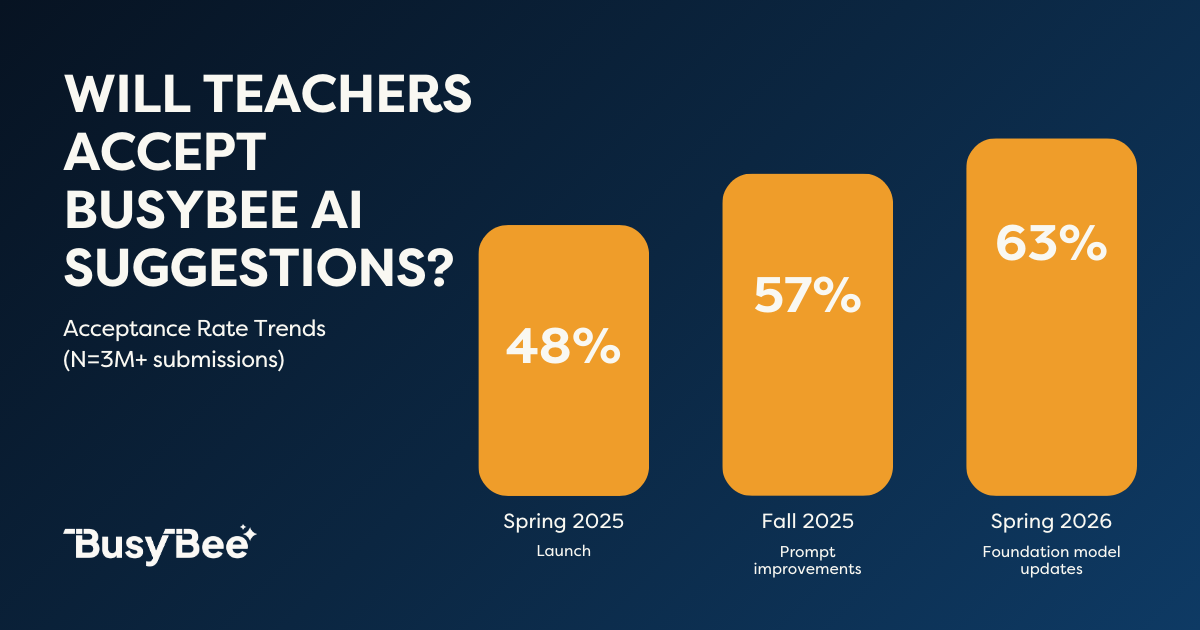
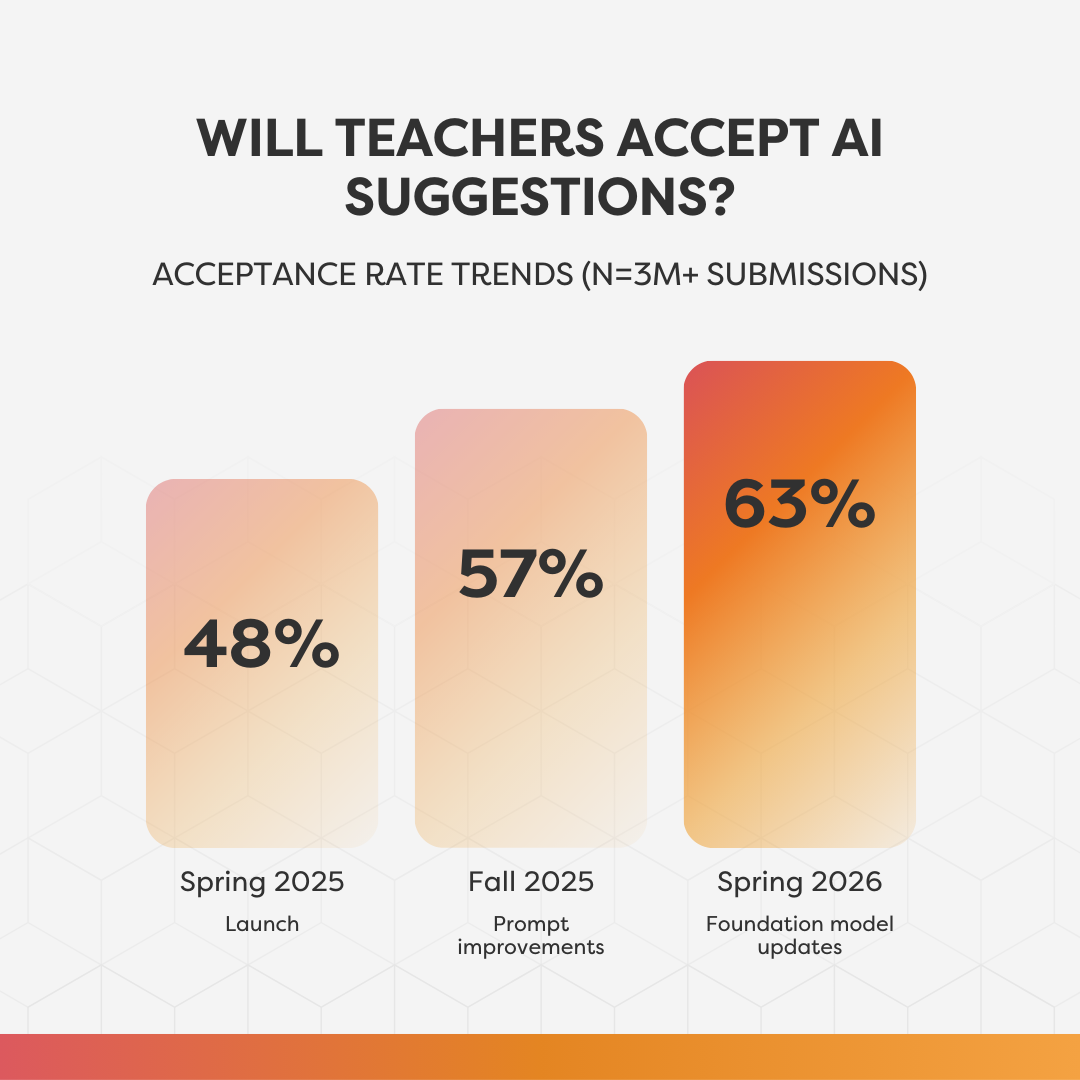
When BusyBee launched in Spring 2025, teachers approved the AI's suggested feedback 48% of the time. Not every suggestion. Not automatically. They reviewed each one, adjusted what didn't fit, and released feedback only when it met their standard.
That 48% was a starting point—and a signal.
By Fall 2025, after significant prompt improvements, acceptance rose to 57%.
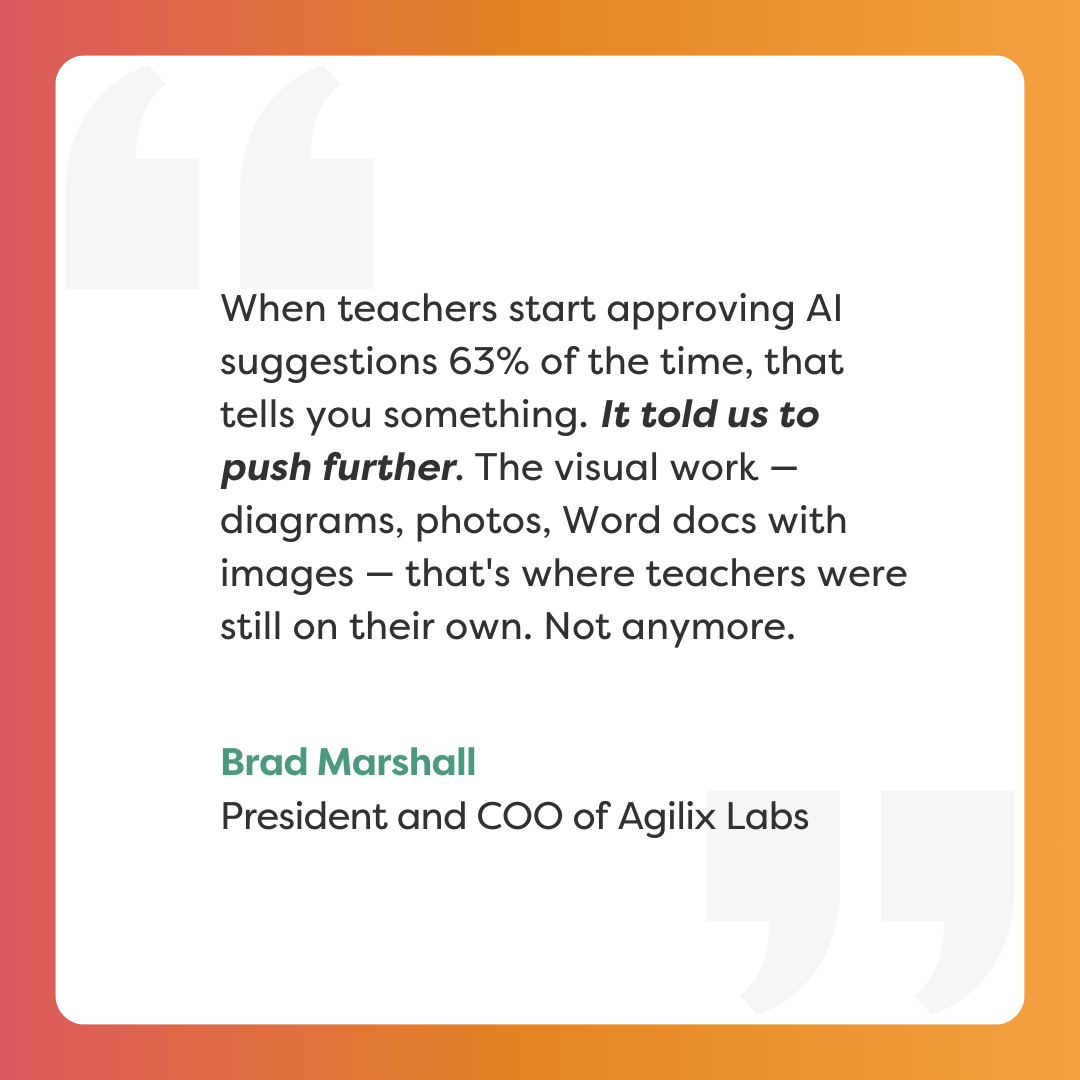
By Spring 2026, following foundation model updates, it reached 63%.
Each jump had a specific cause. That matters. It means teachers aren't just getting more comfortable with the tool over time — the tool is genuinely getting better. The feedback is more accurate, more aligned to rubric intent, more consistent with how that teacher would have written it themselves.
A 15-point rise across three million real classroom submissions is one of the clearest measures of AI product improvement in K–12 education.
What Teachers Are Actually Saying
"BusyBee is the springboard and starting point for effective, informed grading." — Caroline Hebert, High School Teacher, eLearning Academy
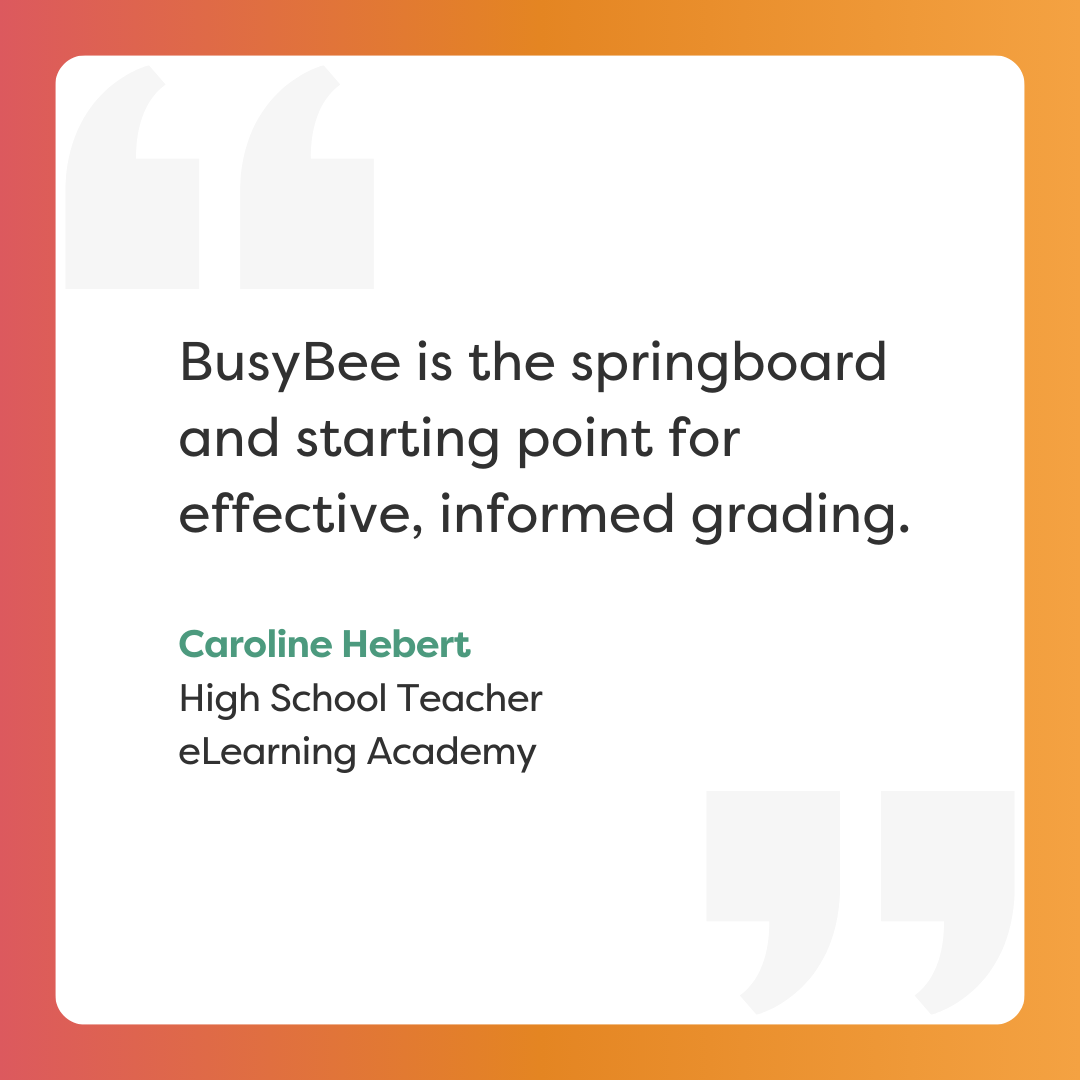
That framing—"springboard", not replacement—captures the design principle that drives BusyBee's results. Teachers stay in control. Every AI suggestion passes through their judgment before a student sees it. Nothing is released automatically.
That's not a limitation. It's the reason the tool works.
When teachers know they're not handing off their professional judgment, they engage with the feedback more honestly. They improve it where it falls short. And over time, the data from those corrections shapes a better product.
The acceptance rate is the output of that cycle running at scale.
75,000+ Hours Returned to Teaching
Across three million submissions, BusyBee has returned an estimated 75,000+ hours of grading time to teachers. That's the equivalent of 36 full-time educators freed from grading for an entire year.
Those hours don't disappear. Teachers redirect them to lesson planning, to student conferences, to the work that actually requires a human in the room.
According to the RAND Corporation's 2025 State of the American Teacher survey, teachers already work an average of 49 hours per week — 10 hours beyond their contracted time. Written feedback is one of the most time-intensive parts of that load and, when done well, one of the highest-impact.
BusyBee doesn't eliminate the teacher's role in feedback. It eliminates the blank page.
The Work Students Actually Submit
Text-based submissions were where BusyBee started. But K–12 students don't only submit text.
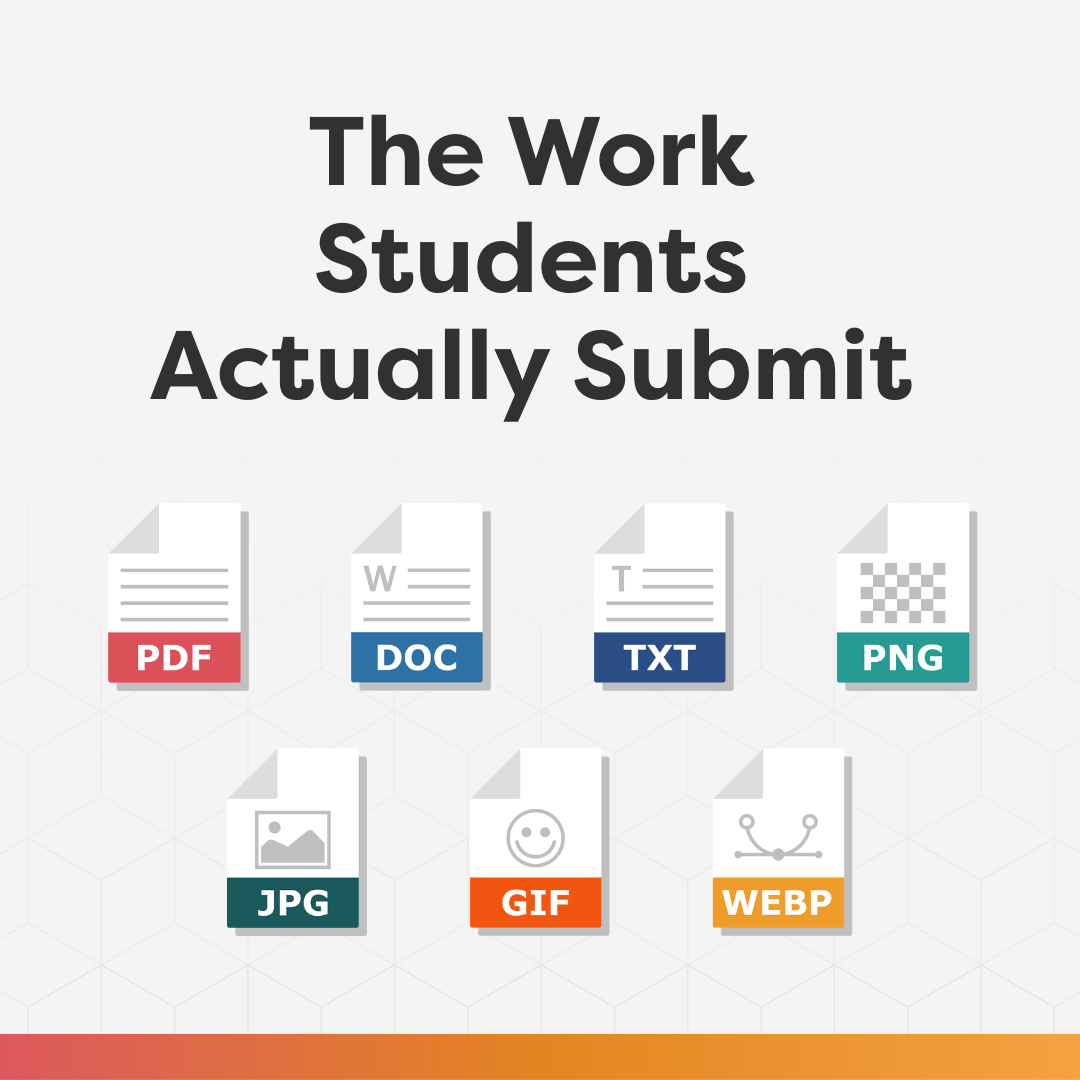
They submit lab reports with embedded diagrams. Math assessments with handwritten work photographed and uploaded. Science observations recorded as images. Word documents mixing typed analysis with charts.
Until now, those submissions sat outside what BusyBee could reach. Teachers who had come to rely on the tool for written work were still on their own for everything else.
That changes with this release.
BusyBee now supports PDFs, images (PNG, JPG, WEBP, GIF), and DOCX files containing images, thus extending AI grading assistance to the full range of work students submit. The same teacher-review workflow applies. Nothing reaches a student without a teacher's approval first.
Built for Education, Built to Stay That Way
BusyBee runs on Amazon Bedrock, providing the security and scalability that school environments require. Student data stays protected. Feedback stays aligned to each teacher's rubric and standards. The system is designed to work within the structures educators already trust—not around them.
The three million submission mark isn't a finish line. It's the foundation of a dataset that continues to improve the product for every teacher and student in the network.
See BusyBee in Action
If you're a curriculum publisher or virtual school looking to give teachers more time for the work that matters, we'd like to show you what BusyBee looks like inside your program.
👉 Read the full press release
BusyBee is part of the Agilix Learning Suite, built for K–12 curriculum publishers and virtual schools.

Contact


© Copyright 2026 - All rights reserved.
